
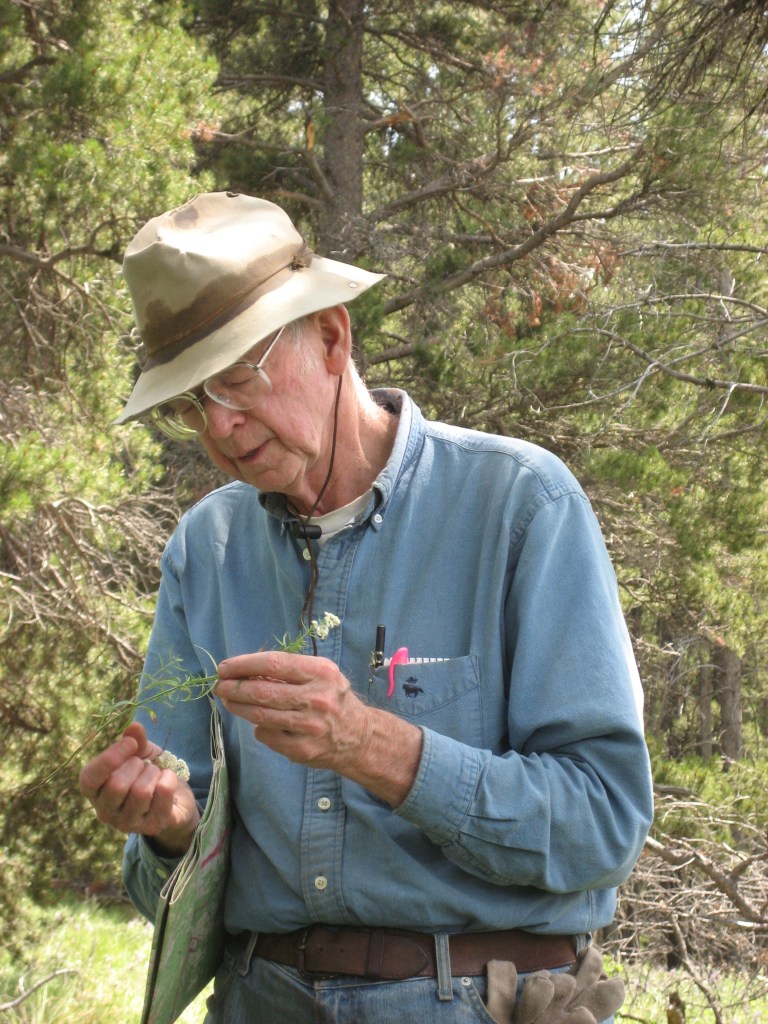
Holmes Rolston, III, was my mentor for over thirty years. I met him when I moved from England to Colorado for a master’s degree in 1990. A renowned environmental philosopher, Rolston died in early 2025.
I made the four-thousand-mile journey for two reasons. First, there was Rolston, the so-called “father of environmental ethics.” He put the field of environmental philosophy on the map. The second reason was Colorado. I had a thing for the mountains.
I’d managed to enjoy the wind and drizzle of northern England for the last 8 years at school and university. But the few glimpses I had stolen of the Alps from a tour bus or a ski lift had hooked me. Fir-clad mountains with a thick cloak of snow were a drug, and I didn’t resist.
Colorado did not disappoint, and nor did Rolston. I spent weekends with friends in aspen groves, rolling my sleeping pad on top of fallen leaves near a creek. On weekdays, I was in the classroom with philosophers and forestry students where Rolston’s sugary vowels enticed us towards his distinctive philosophy of nature.
“Life survives amidst perpetual perishing,” was one of his keystones. Despite abundant suffering and constant death and decay, life endured. New shoots rose from the soil, drawing minerals from cracked rock. Births outweighed deaths and life kept climbing. What resulted had value. He called this achievement ‘intrinsic, natural value’ and it was his signature move in environmental philosophy. That one idea, articulated over decades with poetic elegance, made him famous. Between his first academic article in 1968 and his last in 2023, it was impossible to be in environmental philosophy and not encounter his work.
Now he is gone, I find myself focused on another of his skills: the way he wove three parts of his life into a coherent whole. He was an academic philosopher, a published scientist, and a man of deep faith. Each of these domains is filled with puzzles, complexities, and paradoxes. Put them together and the puzzles rapidly multiply.
A classic Venn diagram has a small section in the middle where three circles overlap. Rolston’s views of science, theology, and environmental ethics fit almost perfectly on top of each other. Three worlds became one. No residue, no awkward belief cast off to deal with later. He wove them into a seamless whole.
Who else can do that?
I know I can’t. I’m not sure if that’s laziness on my part or fear. It takes effort to determine how the distinct parts of one’s conceptual world fit together. It would be alarming to discover the parts that clash.
I’m roughly the same age today as Rolston was when I moved to Colorado. I don’t feel compelled to weave scientific facts and moral beliefs together in the way Rolston did. But having his example is helpful.
He was intellectually thorough and kind. He poured his soul into difficult work. His life echoed that of the pasqueflowers he so admired in the Colorado high country. Struggle and rest. Toil and beauty.
Each spring, when the pasqueflowers emerged, Rolston would climb into the foothills to celebrate them. In pasqueflowers—like the rest of nature—we see perpetual beauty emerge from perpetual perishing. The result is mesmerizing. He called it “the skill of art superimposed on the science of survival.”
If you want to hear more about Rolston, I discussed his work and legacy on the Canadian Broadcasting Company’s Ideas show recently. Enjoy “Gospel and the Landscape: Inventing Environmental Ethics” with Nahlah Ayed.
I also wrote a biography of Rolston a few years back, Saving Creation: Nature and Faith in the Life of Holmes Rolston, III.
 Christopher J. Preston