
It doesn’t feel like something I’d embrace.
I’ve spent my working life becoming an expert on the ethics of emerging technologies. I’m not exactly a luddite, but I’m cautious. I wrote a book for MIT Press, The Synthetic Age, that sounded a warning about trying to ‘outdesign evolution,’ ‘resurrect species’ and ‘reengineer our world.’ The idea of replacing nature with something we design rubs me the wrong way. Our species is not always as clever as we think.
I hadn’t spent much time thinking about Artificial Intelligence (AI) until someone tried to recruit me to speak on a panel, confident I’d come out strongly against. AI, of course, is not just one thing. It will permeate a range of life experiences from web searches to neurosurgery. It already is. But two recent encounters with AI made me more open to it than I expected.
The first was to spend time ‘at the wheel’ of a self-driving car. Scary, I assumed, and obviously dangerous. Like most people, I thought my driving was already excellent. How could a collection of dumb cameras and lidar read the road as well as I can?
Well, in some situations, they can’t. Driving can require interpretation. Has that driver seen me before they back out of the parking space? Do those flashed headlights mean ‘go ahead’ or are they a warning? We can need a little nod, a raised eyebrow, or a sense for what’s expected in a complicated situation. A self-driving car knows the rules impeccably but has little understanding of road etiquette. A human exchange can help.
Get out of the parking lot and the equation changes. Switching lanes, maintaining safe speeds, recognizing that the car in front of you is slowing for a traffic light—this doesn’t require interpretation but rule-following and reaction. Reactions must respond quickly to incoming data. A car running a red light is not what a human driver expects. But it’s what an autonomous vehicle is constantly looking out for. Cameras and chips are much more reliable at data-processing than I am. They don’t get distracted, nor forget the obvious.
The stats are compelling. Self-driving cars are five times less likely to be in a crash involving injuries than cars driven by people. Having watched one at work, it’s easy to see why. Neurosurgeon Jon Slotkin wrote an opinion piece in the New York Times last December arguing that, if self-driving was a drug trial, we’d stop the trial early and prescribe it to everyone because the benefits are so overwhelming. Slotkin sees autonomous vehicles as a significant advance in public health.
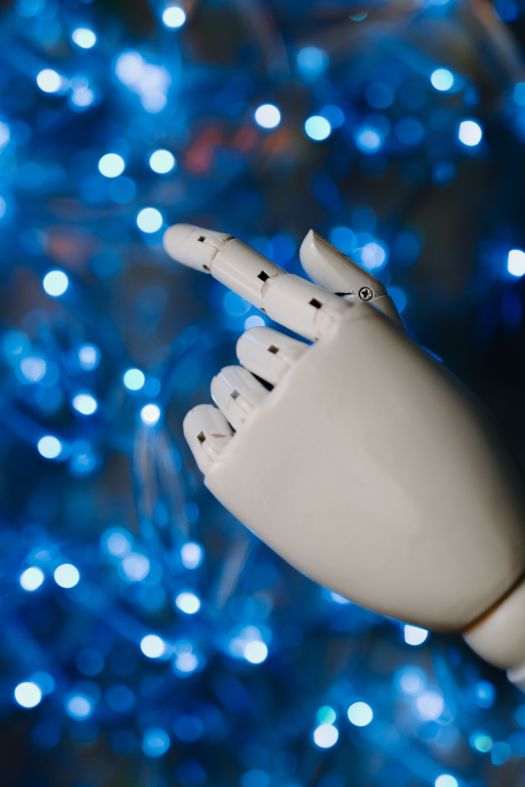
The other AI experience that has affected me was watching a robot break Usain Bolt’s 100-meter sprint record. The occasion was the World Humanoid Robot Games in Beijing. The robot ran the race in 9.39 seconds, beating Bolt’s record by about 0.2 seconds. Other robots at the games kick-boxed, played tennis, and leapt nearly ten feet in the air from a standing start. They compete like people, only they run faster and jump higher.
The athletic feats don’t serve much purpose in themselves. But they demonstrate what is possible. Humanoid robots will be better than us at many things. Pocket calculators have outperformed my prefrontal cortex for more than fifty years. Embodying that level of performance in physical tasks, however, is a step change with consequences. Two million humanoid robots already work in Chinese factories. The number is certain to grow.
With driving and athletic feats, AI has trained machines to do something better than us…. and it’s genuinely impressive. It’s also discomforting to cede one’s perch at the top of a pile. But we must recognize, like Slotkin, when the advantages are real.
As I was pondering how to end this post, several stories hit the news in what a commentator for The Guardian called a week of “apoplexy over AI safety.” Prominent insiders in the industry pleaded for a slowdown, warning that machine superintelligence poses a grave threat to our species. Recursive Self-Improvement in a machine—the ability to learn from mistakes and make itself better at any task—might outrun the human ability to control it. Jacob Coxon, who used to work at the AI company Anthropic, warned that AI ‘could kill us all by the end of the decade.’ By week’s end, I was thinking seriously about abandoning this blog post.
But if I have learned anything from my study of emerging technologies, it’s that finding the right path forward is a complex and delicate task. The extreme views on both sides are fractious and unhelpful. Neither the end of humanity nor the end of drudgery is likely. This is not to say the dangers aren’t real. The challenge is to marshal the good and safeguard against the bad in a thoughtful way. Both these tasks are made more difficult by looking only at the headlines.
My recommendation for the technologies I discussed in The Synthetic Age was to foster widely-shared basic knowledge of what they involve and follow that with open, public debate. It’s striking how few of the extreme predictions about AI are are filled out with any detail. We need to know more about what exactly could go wrong… and what could go right.
A plea for more knowledge and more debate sounds weak in the face of what some predict to be an apocalypse. But this is the human response, the one we as a species are most equipped to offer. It calls for judgement, common sense, community-mindedness, and compassion. These key human traits are still our advantage over AI. We need them now as a matter of urgency.
At the end of their 100-meter dash, the humanoid robots at the Beijing games crashed into giant mattress pads to slow themselves down. Rapid deceleration is harder to manage robotically than running at speed. A couple of the humanoid athletes burst into flames on impact. All of them lay crumpled on the ground, looking utterly wrecked.
Attendants swooped in with stretchers and loaded the spent machines gingerly on top. They left at a brisk pace with the robots prostrate and motionless, looking like casualties removed from a battlefield.
The scene felt surprisingly poignant. Fantastic achievements but at great cost. It didn’t make sense to be sad for the robots. Perhaps what disturbed me was my deep unease about what it all meant for us.


Thoughtful points and I hope our human qualities of judgement, common sense, community-mindedness, and compassion will be able to guide us.
LikeLike